Access Platforms for Vehicles and Rail Wagons – Modularity and Certification
Servicing vehicles, wagons, and machinery at height needs specialist access solutions. How does the modular COSMOS Super Tukan work and who is it for?
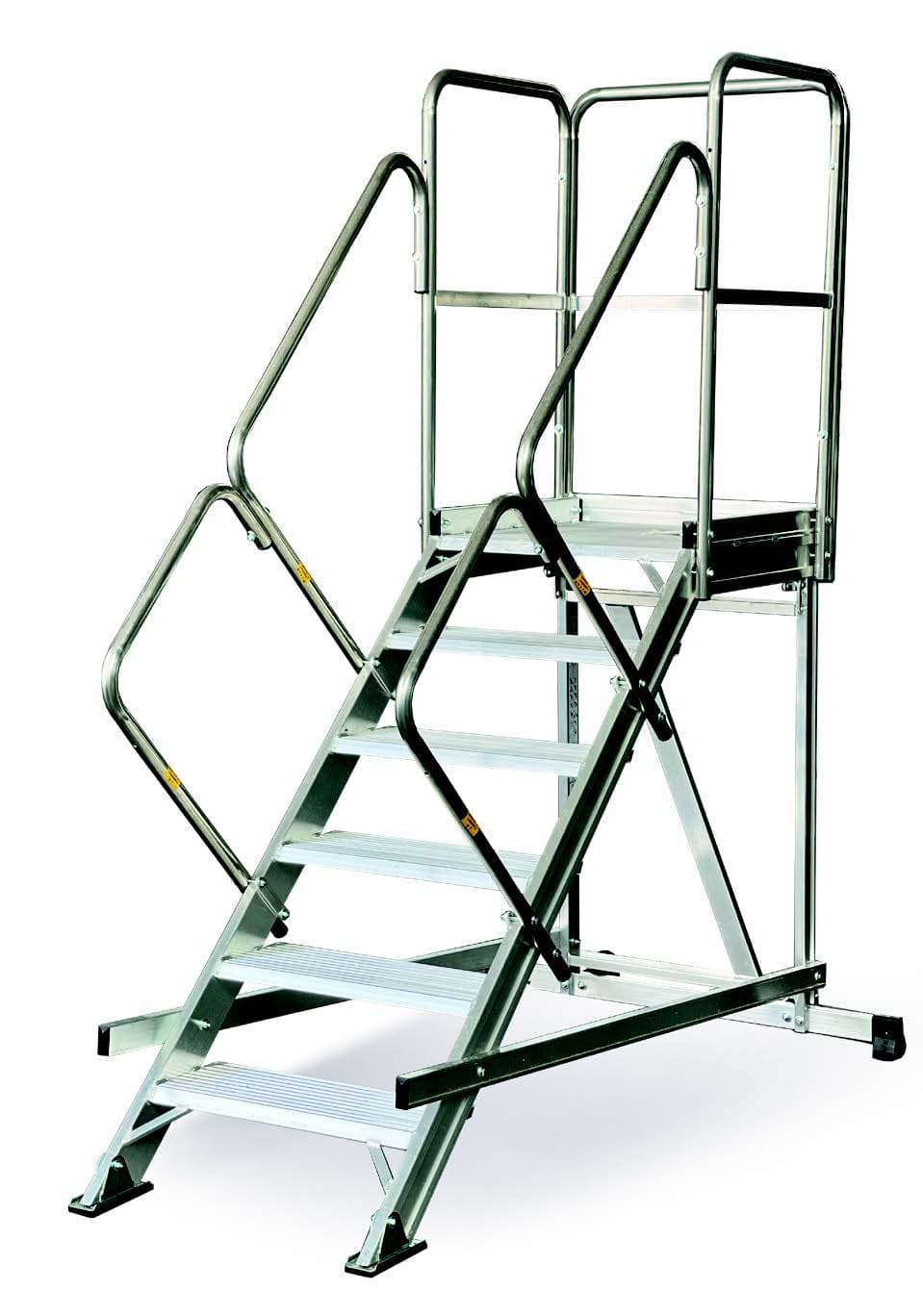
Servicing, inspecting, and repairing vehicles, rail wagons, heavy goods vehicles, or industrial machinery requires access to their upper sections – the roof, engine bay, cab, or side panels – at heights that vary from one vehicle type and one operation to the next.
A standard mobile scaffold tower is not designed for this application: it is built for work alongside a fixed vertical surface (a facade or a hall ceiling), not for work around the curved or irregular shapes of vehicles. And a conventional ladder in an industrial service environment provides neither the stability nor the workspace required.
The solution is a specialised access platform designed specifically for work alongside vehicles – such as the COSMOS Super Tukan.
The Specifics of Vehicle and Wagon Access
Access to the roof or upper sections of vehicles or wagons has several characteristics that set it apart from standard work at height:
Variable access height: different vehicle or wagon types have different heights. The platform must be height-adjustable or available in configurations for different heights – otherwise multiple products are required.
Shape of the working zone: vehicles have curved roofs, side protrusions, antennae, and reinforcement ribs. The access platform must allow approach to the required distance without collision with structural elements of the vehicle.
Need to move along the vehicle: servicing a rail wagon (20–26 m long) or a heavy goods vehicle requires the platform to move along the full length of the vehicle. The platform must be easy to reposition or must be mobile.
Load capacity and number of users: in more intensive service operations, several technicians may be working at a vehicle at the same time. The Super Tukan has a load capacity of 150 kg and is designed for one technician with tools. If several people need to work at the top simultaneously, plan for multiple platforms, one per technician.
Safety near moving vehicles: in some depots and service centres, vehicles move on tracks even while adjacent machinery is being serviced. The platform must be easy to move clear of the running track.
The Modular COSMOS Super Tukan System
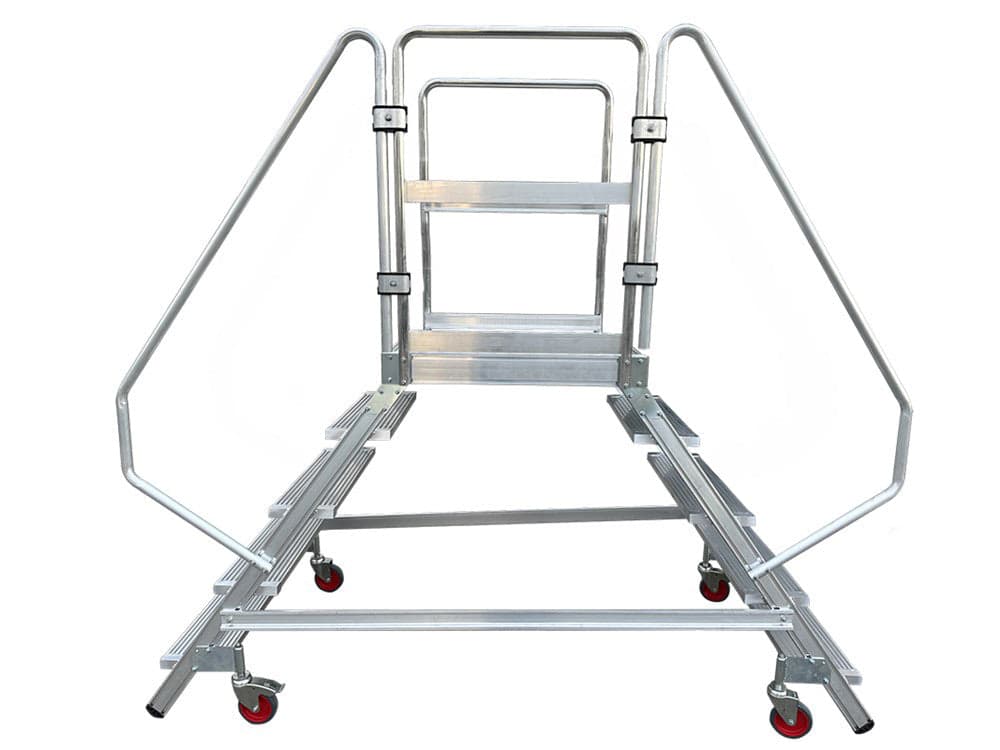
The Super Tukan is an access platform from COSMOS designed specifically for work alongside vehicles, rail wagons, and industrial machinery. Its defining characteristic is modularity: the base system can be configured in various widths, heights, and lengths to match the specific vehicle and operation.
Core principles of the Super Tukan modular system:
Selectable platform width The Super Tukan is available in various width configurations – from compact versions for passenger vehicles and smaller machines to extended versions for rail wagons and large vehicles. Platform width determines how close the technician can get to the vehicle and how much space is available for movement. The standard catalogue range offers a platform 60, 80 or 100 cm wide and 40 or 60 cm deep, 2 to 10 steps and a platform height of 0.40–2.00 m; access is via a ramp at a 45° incline.
Adjustable height The working platform height is configurable – either by constructing a fixed assembly at the chosen height, or (on selected versions) via an adjustable mechanism. This allows the same system to be used for different vehicle types or different working phases (roof access vs. work on side panels).
Modular length For work along the full length of a long vehicle, the Super Tukan can be configured as a modular assembly – multiple sections side by side, creating a continuous walkway along the full length of the wagon. This eliminates the need to repeatedly reposition the platform.
Mobile or fixed installation Depending on operational requirements, the Super Tukan is available as:
- A mobile version (on castors) for flexible deployment in a service environment
- A permanently installed walkway integrated into the service facility or depot infrastructure
Safety features The platform is equipped with a robust guardrail system, an entry gate, and an anti-slip platform surface. On the mobile version, high-performance braking systems for industrial environments are available.
Certification and Documentation
The Super Tukan meets the requirements of the applicable technical standards for industrial access systems and comes with complete documentation:
- Declaration of Performance (DoP)
- Certification to the applicable standard (configuration-dependent)
- User and assembly manual in the local language
- Technical documentation for industrial health and safety audits
COSMOS has its own engineering department, which is able to design the Super Tukan in non-standard configurations and produce the corresponding technical documentation including structural calculations for specific industrial applications.
Examples of Deployment in Practice
Rail transport – wagon maintenance and inspection Depots and rail vehicle workshops require access to wagon roofs for inspection of pantographs, ventilation systems, lighting, and roof cladding. The Super Tukan as a modular walkway along the full length of a wagon, or as a mobile platform for access to individual sections.
Bus and trolleybus depots Access to the roofs and air conditioning units of buses, trolleybuses, or trams. Roof height typically ranges from 3.5–4.5 m – the Super Tukan in the corresponding configuration.
Heavy goods vehicles and tractors Cab servicing, headlamp replacement, bodywork repair, or access to the engine through the top of the engine bay. A mobile Super Tukan is positioned alongside the vehicle; the technician steps up to the platform and works with both hands free.
Industrial machinery and plant Large printing machines, industrial robotic lines, crane systems, or chemical reactors – any equipment whose upper sections need to be accessed for setting, inspection, or servicing.
Aviation – ground support equipment Access to engine nacelles, landing gear, or fuselages of small aircraft and helicopters outside hangar facilities with fixed infrastructure.
FIBRA Version for Electric Vehicles and Traction Systems
For operations where vehicles are under traction voltage (trolleybuses in service, rail vehicles in an energised depot section), the Super Tukan is available in a version with insulating fibreglass components from the FIBRA range. This version complies with CEI EN 50528 and is certified for work near voltages up to 1,000 V AC / 1,500 V DC.
Note: FIBRA certification does not mean direct contact with live parts – it defines safe work in the vicinity of live voltage. The specific conditions of use must always be established in a workplace risk assessment.
How to Order the Super Tukan
The Super Tukan is manufactured to order. To prepare a quotation we need:
- Type of vehicle or machine (rail wagon, bus, heavy goods vehicle, industrial machine)
- Access height (height of roof or working point from floor level)
- Length of the working zone along the vehicle
- Number of technicians who need to work at the top simultaneously (one Super Tukan platform is for one technician)
- Deployment type (mobile or permanently installed)
- Whether live electrical voltage is present (FIBRA version)
- Floor type in the facility
Contact us – we will prepare a technical proposal and quotation within 48 hours.
Sources
- COSMOS catalogue – Super Tukan (PDF)
- CEI EN 50528 Insulating ladders for use on or near low-voltage electrical installations
- COSMOS s.n.c., Albese con Cassano (IT) – cosmos-scale.it
This text was drafted by artificial intelligence from the sources listed and was reviewed and approved by an INTRAPOL employee before publication. Technical data matches the manufacturers' catalogues and manuals as of the publication date.